I’ve cautioned in the past about taking special care to read a publisher’s submission guidelines carefully, and yet confusion seems to rear it’s unshaven head on a fairly consistent level.
Small publishers normally have a niche – a specialty – that sets them apart from the herd. Some houses only take mysteries or fantasy/sci-fi. Some have a hankering for romance, and others look for multicultural. Whatever flavor they’re selling, they’re doing it because they feel they have a good eye for those works and can sell it to the buying public better than anyone else.
We are looking for personal journey works where the issues of a character’s personal introspection and conflict are the driving forces that propel the story rather than themes of action/adventure or murder/mystery.
My lament derives from the types of submissions that invariably crowd my desk. No matter how concise our submission guidelines are, there is that Cool Hand Luke syndrome; what we have here is a failure to communicate. Because of this, I continue to receive a lot of the classic murder/mysteries, spy/intrigue, anything other than stories where the main character’s personal journey is the driving force behind the story. In response, I copy and paste our submission guidelines in the body of my rejection letter.
If you’re unsure whether your story meets our criteria, a query letter is always welcome.
I’ll give a sample of what I’m talking about.
“Ella Jellyburger lost her prized mink stole in Macy’s during a blackout. Her job as a meatpacker gives her little income, and this mink meant the world to her – especially since she is homeless and sleeps under the Hawthorne Blvd. offramp of the 405 freeway. She turns down offers of blankets and Ug boots. She wants her mink stole. Time passes, and she makes slow attempts to move on, allowing the scabs to heal over her heart.
Seeing Stinky Meatcleaver’s dead body wrapped in a fake mink at her job at WeKillEmGently meatpacking center sends Ella into a deep depression as she relives her own loss. The words “I’ve got your mink” is written in Stinky’s blood, and Ella must overcome renewed pain, depression, and agony in order to find out who murdered Stinky and to find her prized mink.
With every clue she uncovers and the closer she gets to the killer, memories of how her sable kept her warm warp her stability to the point where she ODs on grape slushies at 7-11. There, in the cold section, behind the milk cartons that expired last Thursday, Ella confronts the cold hearted killer…and her mink. Is she suffering a complete breakdown, or has she finally come to the end of a long road of tears and sorrow?”
Okay, this synopsis obviously lame as they get – I’m running on far too little sleep and not nearly enough wine. But what I’m trying to show is that the actual murder/mystery is SECONDARY to the main plot, which is Ella overcoming her personal pain.
In short, writers need to analyze their stories to see if they have the proper elements to fit into a publisher’s guidelines. Sure, I could have simply said that, but reading a bad synopsis was far more fun, don’t you think?
Is Your Story Right For Us? Playing the Match Game
December 14, 2006
 6 Comments |
  Uncategorized |
  Permalink
 Posted by lynnpricewrites
The Deliciously Fun Adverb
December 9, 2006Saturday morning is play day for me. That means I can sit in my jammies, slurp coffee, and indulge in perusing my writer’s boards with impunity. I came across an interesting thread about adverbs. You know – those pesky little devils that dilute the verb. I tend to think of them as blood-sucking leeches that devour the vitality out of writing. It’s the lazy man’s version of trying to kick it up a notch.
Verbs, on the other hand, are the backbone of a sentence. They create the action and set the tone. Sticking an adverb into a sentence is like putting on so much make-up that it hides a peaches and cream complexion. Tsk, tsk.
Now don’t get me wrong. Adverbs are lovely little creatures provided they only come out to play in severe moderation and/or stay in their neighborhood – like technical writing, newspaper/magazine articles, manuals – places where the street names are Brevity.
Novel writing is a whole different neighborhood, and the Neighborhood Watch crowd has their phasers set to vaporize. Why? Adverbs “tell,” they don’t “show.” And this is the crux of novel writing – showing.
There’s a far cry between, “He ran slowly,” and “His corpulent body prevented his legs from moving faster than a snail’s pace.”
As an editor, I want to “see” the story, and sentence two offers me an unambiguous picture.
Now, I can hear the voices of discontent: “But aren’t we looking for an economy of words in our writing?” Yes, of course you are, and adverbs provide this. After all, why take a paragraph when you can say it in a sentence? I agree but with a caveat; don’t economize with your words at the expense of your writing. If it takes a longer sentence to convey a point, then use it. A writer can’t communicate “he smiled happily” with the same precision as he can by injecting a nice piece of dialog (showing), “I couldn’t be happier if I were twins.”
As Ray Wong eloquently said, “Adverbs most often become placeholders, vague and dull.” Hip hip hooray, Ray.
Adverbs can act like chocolate – one bite and you can’t put the whole candy bar down. Before you know it, your manuscript is filled with adverbs and the wonderful world you created from your imagination comes out dull and lifeless. If you’re going to use an adverb, by golly, they better come into your neighborhood carrying a full tray of Twinkies and root beer.
Geez, chocolate, Twinkies, root beer? I best take my mixed metaphor downstairs and wantonly devour more coffee.
Leave a Comment » | writing advice | Permalink
Posted by lynnpricewrites
Hook ‘em, Pitch ‘em, and Reel ‘em in
December 8, 2006After attending our distributor’s sales meeting where we were afforded the opportunity to personally pitch our upcoming titles, I was struck with the similarities of my job that night and every writer who queries an editor or agent. And that would be The Great Pitch/Hook. Its sole purpose is to whet the appetite of the person sitting on the other side of the desk.
I can’t speak for agents attention spans, as the only personal meeting I’ve had with one is Janet Reid of the JetReid Agency, and she’s as kind and caring as they come along with possessing a great sense of humor. I, on the other hand, am cranky, generally impatient and want to cut to the chase. This is the reason why I love the writer who understands my limited attention span and takes special effort to wrestle it to the ground before my brain wanders off trying to remember where I parked my car.
Effective hooks have two consistent qualities:
They tell me why I want to read their book.
I’m not talking about the usual platitudes of, “it’s brilliant/funny/my dog loved it/my aunt couldn’t put it down.” It doesn’t matter who else loved it – I have to love it. You have mere minutes to capture someone’s attention, so make it count. Read your synopsis and look for the qualities that answer the question, “Why do I want to read this book?”
They give me a very brief idea of what the book is about.
A cover/query letter is short and simple, so resist the temptation to give anything resembling the synopsis. This also includes avoiding detailing the entire cast of characters and the subplots. Yikes, just put hot pokers through my eyes. Here’s an example of an effective pitch.
How many of us have said, “One of these days…?” The dark wit of East Fifth Bliss takes this question to the limit through Morris Bliss, a thirty-five year old Walter Mitty type, who is clamped in the jaws of his own lack of inertia. A taciturn father, a hot-blooded eighteen-year-old girl in a Catholic school uniform and a friend who has a nose for finding trouble serve to send Morris Bliss’s failure to launch life into the abyss, and he must learn to adapt if he is to survive.
Sounds simple. In truth, it’s agonizing and takes a lot of time and refinement. Like writing a synopsis, the hook is the initial face to your work. Take care that you have a good face on it.
2 Comments | Uncategorized | Permalink
Posted by lynnpricewrites
Batter Up, Get Ready for the Pitch
December 5, 2006 We spent three glorious days in New York. Again. I could definitely get used to this, as I’ve fallen in love with the place. We were there exactly a month ago, and, as we boarded the plane, I felt like breaking into Willy Nelson’s “On the Road Again.” However, given that no one (especially airport officials) has a sense of humor, we felt it best if I refrain since I can’t carry a tune.
Unlike last month where we did a number of author readings, we were in NY to attend our distributor’s sales meeting. This is where we get to do what we force you all to do when you submit – meaning that we have to pitch our upcoming spring and summer releases. Pitching is an art. You have to convey the most exciting and poignant parts of each title in a tiny amount of time.
I stood in front of the room looking down at my list of our upcoming titles before gazing into the faces of over fifteen salespeople and our distributors. I wanted to shout, “I love, love, love these books, and twenty minutes isn’t enough time to say all I have to say about six wonderful new titles! You swine! You’re hampering my ability to effectively communicate all that I want to say! These books are gold!”
As I began my pitch, it hit me that I had been sucked like an overactive Hoover into the very vortex that hamstrings nearly every writer when they submit to agents and editors. Brevity dictates our worlds due to the sheer volume of submissions. However, it is also dispassionate and succinct.
One half of my brain screamed out, “Just the facts, stupid!” As a writer, I know what it’s like to pour my soul into my writing, teasing my brain to release the words into my fingers. The desire to yammer on about a novel’s endearing qualities and lovely plot is great when put into a room full of salespeople. You become convinced that if they know the books’ every nuance, it will impact and enhance sales.
I love our books, and even though I didn’t write them, my soul has participated in their production. I wanted Mr. Southeast Territory to know how my chief editor and I stayed up until the wee hours of the morning banging our heads over a particularly tough edit. I felt sure that Ms. Northern Territory would find the humor of how one of our cover designs looked great up close but ended up resembling a Rorschach Test on crack when giving it the ten foot test. And how about Mr. Western Territory? Surely he would have appreciated knowing how a book’s character touched my heart and altered it forever.
Of course, in the end, selling books has nothing to do with the personal journeys our editors, writers, designers, and staff take to get our books produced. What matters in a pitch session is communicating the guts, the meat of the product. What is called for here is taking a year long process and mashing it down to a one sentence plot, a few short paragraphs about marketing, promotion, reviews, and target audience. By golly, I went against grain. They had to know how each of these new titles touched my soul and why we felt they were so important to the Great Readership. They asked a lot of questions, and I hoped I’d gotten it right.
After the meeting, we had several sales people come up to us and thank us for our outstanding presentation, and they looked forward to pitching our books. As we smiled and shook hands, I reserved a silent thanks to our authors for their talent. They had gotten it right, too.
2 Comments | Uncategorized | Permalink
Posted by lynnpricewrites

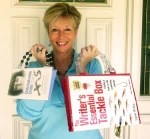
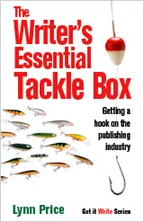 If you want the inside scoop on what floats our boats, The Writer's Essential Tackle Box is a must have.