Say what?

March 29, 2010

It’s been a while since I bleated on about dialog tags, and the discussion becomes a bit of an issue on the various writer sites I frequent. I’ve talked about how dialog tags – the oldy, moldy “he/she said” – creates a ka-thunk cadence if you don’t mix it up a bit to create balance. But it’s more than that. It robs the reader of action, color, dimension. This means the author either neglects to put that color/dimension/action in, or they have to inject it someplace else.

Example:

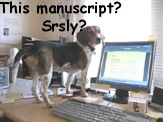
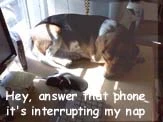
“You talkin’ to me?” the beagle asked. She wore a surly expression and spit when she talked.

or an even worse example because we are robbed of any kind of description:

“You talkin’ to me?” the beagle asked.

Alone, the sentence won’t cause liquid to shoot out your eyeballs. But when you multiply this times an entire manuscript, it comes off as pedestrian.

Said vs. descriptions

We readers like to know what ‘s going on during dialog. Simple “he said” is tedious without some semblance of setting the scene. All you have are talking heads. And who cares? It’s a snoozefest. You may have a terrific book filled with great characters and fabulous dialog, but you can kill it by forgetting to give us some tactile engagement. You need to go from good to great. Are the characters scratching their bellybuttons, drinking a chocolate martini, reading a menu, petting an errant, lazy beagle?

Descriptions:

Rather than using a tag, writers can use descriptive writing to identify the speaker.

The beagle adjusted her hat and rearranged her lacy, pink six-shooter. “You talkin’ to me?”

Overworked and Underpaid Editor’s fingers twitched as they neared her evil red pen. “Yah, I’m talkin’ to you. File those contracts, or the tequila bottle gets it.”

No tags, yet we know who’s doing the talking. The description allows the reader to see the action and heighten their interest.

Descriptive tags

The manner in which you utilize a dialog tag is subjective because you’re looking for a sense of balance. I know many editors here in the US  will yank out every tag that isn’t “said” because the tags take on more importance than the dialog – as in:
” he intoned
begged
ordered
shouted

pleaded
laughed
yelled

…you get the idea. This strikes me as editing by numbers because it’s not that simple. Again, it’s about balance and how the sentences flow and play off each other to create a nice cadence. So while I’m not necessarily that picky about something other than “said,” I do have my radar set to stun because I’ve had manuscripts chock-a-block with these types of tags, and they create a cluttered mess. The overabundance strikes me as fifth-grade writing, and I’m looking for effortless sophistication.

Descriptive tags cause a showdown between Show vs. Tell

The by-product of using descriptive tags is the tendency to create a gunbattle between Show vs. Tell. Over reliance forces those tags do the work of the writing. IMO, it places way too much importance on the tag, thus robbing the reader from seeing the full picture.

“Look, a beagle that drinks margaritas!” he laughed.

Again, as a stand-alone, this is fine. But when a manuscript is filled with descriptive tags, it’s dull and lifeless because it’s all Tell. So what? The dialog is curious – a drinking beagle? Doesn’t that deserve something more than a “he laughed”? This is what I’d rather see in a submission:

He put his beer down and stared, disbelieving, at the apparition sitting at the bar. “Look, a beagle that drinks margaritas!”

To me, it’s the difference between a front yard that has a nice lawn and a front yard that explodes with flowers, bushes, and a patch of deep green grass. In this day and age of stiff writing competition, it makes sense to pay close attention to something as seemingly small, but achingly important, like our little friend, the dialog tag. Use him sparingly and with balance.

Otherwise we may be tempted to utter, “Say what?


He Said, She Said

July 31, 2008

Dialog tags drive me buggy when they follow every line of dialog. They also drive me buggy when writers seek to avoid using “said,” thinking that it’s boring. Instead, I see things like this:
He snorted
He laughed
He threatened
He guzzled
He burped
He cried
He yelled
Blah, blah, blah…

Only one thing should be going on with dialog tags: identify the speaker.

But too often, writers use dialog tags as a crutch to reveal emotion, hence the above examples, or don’t realize that they don’t need the tags – especially when two people are talking. Passages of dialog that has a “he said” after it creates a ka-thunk ka-thunk pace.

“Blah, blah, blah, blah,” he said.
“Blah, blah, blah, blah,” she said.
-yawn-

It’s unnecessary and unimaginative. Rather than using a dialog tag, use action instead.

Example:
Overworked and Underpaid Editor stood in the middle of the office and stared at the floor, now littered with envelopes and tip sheets. “Overpaid and Underworked Assistant, get in here immediately and clean up this abomination.”

Overpaid and Underworked Assistant cringed in the darkness of the closet where she’d been having a major makeout session with the computer technician who’d arrived to reboot her hard drive. Reboot her hard drive, indeed. “Coming, boss.”

No tags. Instead, I used this to set the scene while still identifying who is doing the speaking. This adds richness to a potentially boring scene. I’m not saying that you won’t use dialog tags, especially when there are three or more characters talking. Sometimes you need a more rapid fire pace. But if writers avoid overusing the “he said, she said” tags, this goes a long way to avoiding ka-thunk.


Dialog Formatting-a-occus, Dialog Tag-a-tosis, and Talking-Head- itis

April 19, 2008

These are three diseases that infect many potentially good works, and it all comes down to education. I’ve been amazed at the number of writers who don’t understand how to format dialog, use too many dialog tags, and engage in talking heads.

Underpaid Editor grabbed the blender.
“Margaritas for everyone!” she shouted excitedly.

Overworked Intern tossed the slush pile into the air.
“Whoopie doo!” she screamed elatedly.

While I’m a sucker for a good margarita (and I do make the best in the world), this is a case of incorrect formatting. I just finished reading a submission where the writer had formatted every bit of her dialog in this manner. I was constantly confused as to who was doing the talking; and no, it wasn’t because of the margaritas.

I have a lot of people asking me how to know when to keep the sentences as one paragraph. Simple. You have a lead-in sentence and the dialog. The lead-in sentence matches the character’s action with the upcoming dialog, so it belongs in the same paragraph.

first sentence:
Underpaid Editor grabbed the blender. “Margaritas for everyone!” she shouted excitedly.

Overworked Intern tossed the slush pile into the air. “Whoopie doo!” she screamed elatedly.

The second offense in this example is the dialog tags. Writers rely on them to convey emotion, and this puts the stress on the tag and takes away from the actual dialog. Put the emotion into the lead-in sentence.

Dialog tags should be kept to a minimum because they tend to have a clunking sound after a while. There are so many better ways to reference multiple characters – hello lead-in sentence. They are so underutilized, and the results are dull, flat reading. Use your lead-in sentence to convey movement or facial expressions – anything that will add dimension to the characters – and get rid of the dialog tag.

Underpaid Editor grabbed the blender. “Margaritas for everyone!” she shouted excitedly.
Overworked Intern tossed the slush pile into the air. “Whoopie doo!” she screamed elatedly.

Now becomes:

Underpaid Editor ended her long and stressful week by grabbing the blender she kept stashed in the bottom drawer of her desk. “Margaritas for everyone!”

Overworked Intern tossed the slush pile into the air and jumped with excitement. “Whoopie doo!”

The third offense is the Talking Heads. That’s a case where there is nothing going on but dialog. This is fine if done in small doses, as it is here. But have this going on for a page, and you want to scream. Or drink. It’s all about flow. Besides, you’re missing a great chance to add flavor to this dialog.

Are there any of those little umbrellas we can put in the glasses?”
“You said you’d bring them.”
“I thought Underworked CEO was going to get them.”
“No way. He took all the petty cash to buy water balloons to throw at the UPS guy.”

Now becomes:

Overworked Intern watched her boss pull out the tequila, limeade, and ice. “Are there any of those little umbrellas we can put in the glasses?”
Underpaid Editor had to speak over the loud whir of the blender. “You said you’d bring them.”
“I thought Underworked CEO was going to get them.” Overworked Intern’s face fell in disappointment.
“No way. He took all the petty cash to buy water balloons to throw at the UPS guy.”

(those of you who caught the abysmal adverbs in the original version get a free margarita)Yes, I know, Hemingway it ain’t. But I used nary a tag, I reformatted this so the reader knows who is talking at all times, and I got rid of the talking heads. Margaritas anyone?


Follow

Get every new post delivered to your Inbox.

Join 851 other followers

Powered by WordPress.com