There is this strange moment of brain-damage-freakazoid-cheek-sucking realization when authors are no longer in Before The Book Deal Land, and they have entered into Book Deal Land.
Before The Book Deal Land is a place of conjecture. “Once I have that book deal, crowds will part and form a rose-petaled trail for me to tread upon.” It’s a fun place to dream about interviews with Katie Couric and photos on the cover of TIME magazine. Maybe your own private island and hunky cabana boys peeling you grapes.
Book Deal Land is where reality smacks authors upside the head with all the grace of a drunk gazelle. It’s where you face deadlines and organize promotion plans. It’s the land where decisions are made, and where changing your mind is a luxury. It’s a land where you are beholden to much more than just your imagination and your computer. Lots of people are involved in Book Deal Land, and you need to be ready for it so the production process goes as smoothly as possible.
To get you ready for Book Deal Land, I thought I’d touch on some issues that I’ve observed over the past ten years.
Hurry Up and Wait
You’ve signed your contract, the ink is barely dry, and you’ve blabbed your new book deal all over the place. You’re fired up and ready to dig in. No longer are you in charge of your own schedule. Your time now belongs to your editor and her frenetic schedule. This is a hard concept for a lot of authors because they’ve been captaining their own ship for a long time, and now you’re expected to dance to someone else’s iPod. Meh, don’t you love it when I mix metaphors?
You’re hot to trot, ready for Freddie, Gentlemen, start your engines. After all, you’ve been in the “busy groove” for the entire time it took you to write your book. You got up and wrote and wrote and wrote. Your book kept you organized. It was the very first thing you thought about in the morning, and the last thing you thought of before your nightly coma. And oftentimes, in between your nightly coma. The heck with someone else’s iPod, let’s get moving, right? Um…notsofast.
I remember when I completed my novel, I had this sense of immense pride – and loss. My gawd…I’d spent a year researching, writing, immersing myself into the world of my characters. I ate, drank, and slept my book. Suddenly, it was done. Fini. Now what? I felt like macaroni without the cheese.
I was ready for action, baby…only my editor had three other manuscripts before me. It. Was. Agonizing. Experiencing this helps me understand our authors and their questions of “So when do we start editing?”…and the sucky answer is, “When we’re ready.”
So the short-order advice here is to start writing another book. It’s a lot more fun than waiting and biting your nails to the quick. This is a game of hurry up and wait, so the sooner you appreciate this annoying element, the easier it is for everyone involved in the production process of your book.
The Editing Process
Editing takes time. Sometimes lots of time. Since we’re a small trade press, I can dedicate four months for editing a manuscript because I want it right, not fast. The big guns don’t have that luxury since time is an even bigger enemy for them. What is universal are the emails asking, “Arewethereyet? Arewethereyet?” Editors have to stop what they’re doing to write back, “I’m working on it, I’m working on it.” or “You’re in the queue.”
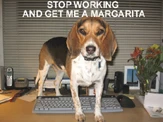
I know it seems like we’re playing beagle frisbee and sucking down margaritas, but it’s a lot more involved than that. We first read the manuscript again, making detailed notes next to sentences or scenes that we feel need editing on some level (line edits). Then we do a detailed write up that clarifies certain strengths and weaknesses that we commented on within the manuscript. This process can easily take about 7 days (8-9 hours a day) if we had the luxury of doing only that for those 7 days. When I’m editing mode, I usually try to go to ground, but it isn’t always possible, so that editing time is expanded. A lot.
After we send you those edits, you’re given a certain timeframe in which to make the rewrites/edits and send it back to us…whereby we repeat the process all over again. Depending on how much retooling is necessary, this process can go back and forth several times until both parties are happy with the result. The next process is going through and checking for missing punctuation, misspellings, missing words, etc.
Then we format the manuscript and go through the checking process again…looking out for any funkiness. Then we send it back to the author for a final run through and final author approval.
Things that make me want to mainline antifreeze: This final stage is the hard read, where both parties check for spelling or punctuation or formatting blunders. This isn’t the time to ask if you can rewrite a scene because you’ve “had time to think about it.” That ship has done thar sailed, and it ain’t coming back to port.
I don’t know why it is, but I’ve had many experiences when, at this final stage, authors wanted to make huge changes. Maybe it’s because they are finally taking the whole process seriously and realize THIS IS IT, and do the hard reading they should have done two or three sessions ago. I want to scream, and let me explain why.
The manuscript has already been formatted, which means pages and text align exactly the way the interior designer wants them to align. If you toss in a paragraph or three, it throws everything off kilter for that chapter, and possibly for the entire book. There are cases where this can’t be helped, but even the beagle runs and hides when I have a request for last minute changes or rewrites.
Take this process seriously, and do the hard read every time your editor sends your ms back to you with changes. Print it out…it’s much easier to find warts on a printed page rather than a computer screen. It’ll save your editor from having to join AA.
Cover Design
Authors always confront cover design with a mixed bag of trepidation and excitement. This is the face of your book! People will associate that cover with you forever, so it goes to reason that fear is an active element to this process.
There is a lot of components that go into cover design that most writers don’t realize. I’ve had requests to use a graphic designer’s work for covers, only to reject them because as good as the graphic designer is, he doesn’t know squat all about book covers. The detail may be so minute that one has to get very close to the book to see the intricate design. That may be fine for you, but what happens when customers enter the store from ten feet away? The only thing they’ll see a purple blob. This isn’t the tone you’re looking for when trying to entice readers to come closer.
Text is a very touchy issue as well, and you wouldn’t believe the conversations I’ve had with our sales and marketing guys over title treatments. It’s serious business. Everyone tries their best to meet/match the author’s expectations because they want the author to be excited and proud. Does it always turn out that way? No, sadly. But there should be plenty of discussions about your cover art, so you’re able to voice your opinions before they finalize the cover. And at that, not every author will necessarily be pleased.
What do you do if this happens to you? My recommendation is to suck it up. Sounds harsh, I know, but what choice do you really have? Are you going to throw a hissy fit and refuse to promote your book? Will you trash your cover to anyone owning a pair of ears? Seen it, and it’s embarrassing. What you’re doing is making a mockery of yourself by playing the bad sport…which is exactly what people will remember…not your book. Grace under fire is one of the most admirable traits in this business, and I adore any author who smiles through the pain.
Promotion/Marketing
This is a mixed bag because expectations vary from publisher to publisher. The biggest gift you can give yourself is to discuss this before you ever sign the contract. Knowing what is expected of you and of your publisher keeps the distinction clear for both parties. Publishing is tough enough without having to play the “I thought you were gonna do that” game.
Your publisher should be taking care of the national distribution and promotion. This is a huge bucket that takes money and contacts, so every publisher will have their own way of doing things. Be sure you’re clear on what they will do.
Flexibility is a lovely thing, and you may find that your editor and their marketing guys will be happy to take on something that’s too big for you to handle by yourself. An example of this would be sending media kits to cardiologists for your heart book. This is outside your publisher’s normal fare, which is focusing on the medical media (Dr. Oz, AHA, for instance), but they may see the added benefit of going directly to the source (cardiologists) in hopes that they’ll recommend it to their patients as the go-to book for heart problems. Sure, you could do this yourself, but this might be better coming directly from the publisher.
The idea is to combine forces to cover all your bases, and promotion work varies depending upon the genre. There isn’t anything I won’t do for a proactive author, and I think most editors feel the same way. The more ideas you have, the more willing they may be to add those ideas to their promo/marketing plan
So as you can see, the Book Deal is only the beginning. Go ahead and slurp down the champagne and dance in the streets, but also remember that it takes a great team to put out a great book, and it all begins with you! Now go out and be brilliant.
Like this:
Like Loading...

 Kit Ward | Tagged: Kit Ward |
 Posted by lynnpricewrites



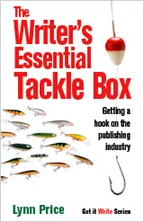 If you want the inside scoop on what floats our boats, The Writer's Essential Tackle Box is a must have.